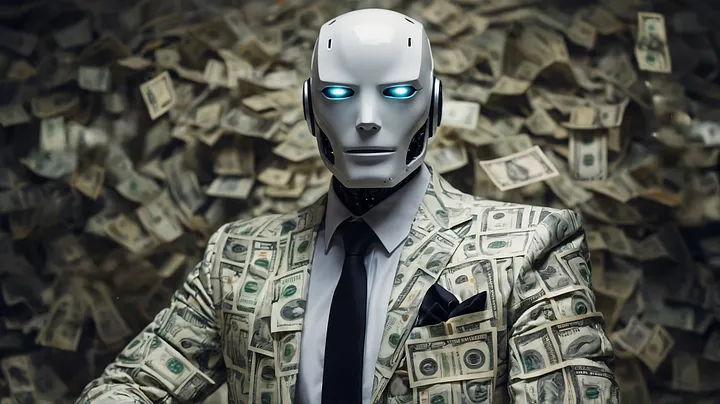
Is there a limit to AI?
Many of us have heard of AI and may even have an idea of what it is, but have you ever wondered if there is a limit to AI's capabilities?..
Is there a limit to AI? In this text, we explore the question of whether or not there is an upper limit to AI.

Artificial intelligence has been evolving steadily over the past few years, and it seems like there is always something new in development. However, many people still believe that AI app has limits, that it can only do so much, that it can only go so far. But is that true? While it is true that AI has some limits, we cannot deny that its potential is immense. So let's take a look at what AI is capable of.
As AI continues to grow and develop, it is almost impossible for us to predict what its limits might be. AI app is capable of performing tasks that humans can also do, but faster and more efficiently. With Deep Learning, AI can understand and recognise patterns in huge data sets, surpassing human capabilities in this area. This makes AI extremely useful in industries such as healthcare and finance.
AI major advances:
One of the areas where AI has made great strides is in natural language processing. It can understand and interpret different languages and dialects and analyse contexts and meanings. This capability has made AI the backbone of the booming chatbot industry, where customer service needs to be available 24/7. In addition, video and image recognition is an area where AI excels, and this technology is being used in areas such as security, marketing and education.
AI certain limits:
However, there are also voices that place certain limits on AI. They argue that AI will always be limited by the quality and quantity of data it has access to. In other words: If AI does not have access to large or accurate data sets, its capabilities are limited. Furthermore, AI might have a hard time when it comes to creativity and emotional intelligence, as these are human specialities that are not yet fully understood by machines.
Nevertheless, AI app will continue to grow and exceed human expectations. Imagine smart homes, fully autonomous electric cars and medical diagnoses without human intervention - all of these are possible in the near future. So it is clear that AI has the potential to surpass humanity's wildest imaginings.
In summary, while AI may have some limitations, we can still be excited by its possibilities.
Is there a limit to AI?
Yes, there are limits to AI, and these limits are determined by several factors, including the complexity of the task, the quality and quantity of data available, the computer resources available, and the algorithms and models used.
The limitations of AI include:
Lack of general intelligence: while AI can perform certain tasks very well, it does not have the general intelligence and flexibility of humans. AI is still limited to the tasks it was programmed for and cannot perform tasks outside its area of expertise.
Data limitations:
AI needs large amounts of data to learn and improve its performance. If the data is incomplete, distorted or of poor quality, the AI system cannot perform well.
Data processing limitations:
To perform complex tasks, AI requires significant computing resources, including powerful processors and memory. This can be a limiting factor for AI in many applications, especially those that require real-time processing or where resources are limited.
Ethical and legal considerations:
AI can raise ethical and legal concerns, including privacy, bias and transparency. These considerations may limit the use and development of AI in certain contexts.
Human limitations:
AI is designed and programmed by humans and is therefore subject to the limitations of human knowledge, bias and values.
Although AI has made significant progress in recent years, there are still limits to its capabilities, which may vary depending on the application and context.