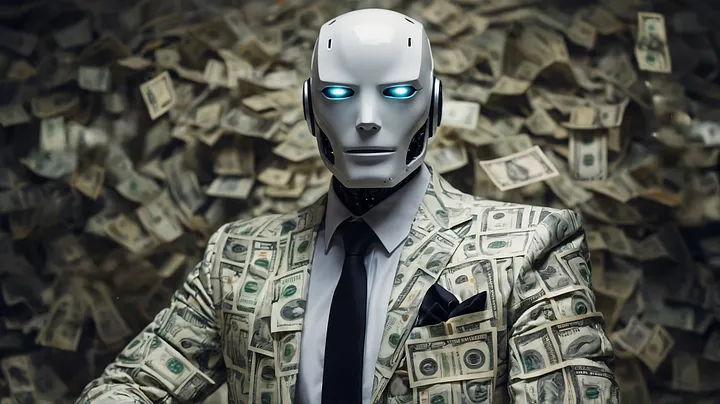
Will AI be smarter than us?
Today's topic is quite interesting - "Will AI be smarter than us?" ...

Will AI be smarter than us? Artificial Intelligence:
Artificial intelligence (AI) has been a hot topic of discussion for years and has become even more relevant with recent technological advances. As AI technology continues to evolve at an unprecedented rate, many skeptics are wondering if it could one day surpass human intelligence.
AI actually is. Artificial Intelligence:
First of all, it is important to understand what AI actually is. Artificial intelligence is the ability of machines to perform tasks that usually require human intelligence. This includes things such as language comprehension, decision-making and sensory perception.
Improving machine learning :
With the exponential improvement of machine learning, AI is more advanced than ever before. In fact, AI can now solve problems faster and more efficiently than humans. From supercomputers that can learn independently to autonomous vehicles, AI technology has revolutionized various industries - it makes work and life easier.
Speed of data processing:
Machine learning algorithms have increased not only the speed of data processing, but also the quality of the results. They are constantly learning and gaining new knowledge about everything they are programmed for. However– the question arises - is there a limit to how intelligent an AI system can become?
The knowledge of man:
AI systems are designed by people, so it is obvious that the upper limit of their learning and knowledge would be man himself. However, it is not possible for AI to surpass human intelligence. Humans are capable of making decisions that are morally, ethically right or wrong, whereas an AI system would only make a decision based on the available data.
Understanding the context:
AI can work beyond human potential, but it will never possess the true humanity to understand context, learn creativity or show emotions. The knowledge of an AI system will only be what it is programmed for, and there will always be a lack of the general awareness that people possess.
AI is advanced and can perform tasks:
So there you have it - while AI is advanced and can perform tasks beyond our potential, it will never surpass the knowledge, experience and creativity of human intelligence. What are your thoughts? Let us know in the comments section below.
Will AI be smarter than us?

Can artificial intelligence be like us? Can a machine ever be as intelligent, as independent as a human being? The path to strong AI would definitely be Langava's gaze is lowered when she confesses to the man in front of her: "I want to be with you.
" The specially selected dress only allows a glimpse of her metallic body at the neck. She hesitates before asking, "Do you want to be with me?«
Ava from the movie:
The artificial intelligence Ava from the movie "Ex Machina" stands for a human dream: an artificial being that thinks and feels. Created by man in his own image. A machine with mind, consciousness, will, emotions, in short: with spirit.
General Artificial Intelligence:
Strong or general artificial intelligence is what researchers call such machines. However, so far they exist only in films and books. Today's AIs are extremely specialized, they can only cope with a single task. AlphaZero can beat human masters in Go, but "Man don't fret!" is a mystery to him, and he can not distinguish apples from pears. In everyday life he would be hopelessly lost.
Building machines Building machines:
Is it even possible to build machines that find their way around the world, just as we humans do? Yes, who is endowed with self-confidence, will and feelings at all? What are the challenges facing the developers? And what could the path to a human-like machine look like?
The simplest approach seems to go like this: you choose a set of elementary human skills and behaviors – such as language, general knowledge, emotional reactions – and program them into a computer. Then he is trained to behave like a person in any situation. Whenever today's computers show seemingly human behavior, they have been prepared in this way. If Siri responds quickly, it's because a programmer foresaw the question and Siri gave a suitable answer.
WHAT IS THE TURING TEST?
Such a machine can be quite convincing, in fact, it could pass the Turing test. In 1950, computer pioneer Alan Turing proposed how to test whether a machine exhibits intelligent behavior comparable to that of humans. A test subject talks to a machine and a human being; if he cannot determine which of the two is the machine, he has passed the test.
The Turing test is popular, but it has one problem: it does not check whether the machine is like a human, but only whether it behaves like one. It simulates human behavior, it leads us astray. In fact, some machines have already managed to do this to some extent. in 1966, the chat program "Eliza" convincingly mimed a psychotherapist by responding to keywords in the subjects' messages (for example, "Family") with phrases ("Tell me more about your father!«).
British subjects fell for the chatbot "Eugene Goostman" in 2014 because they thought they were chatting with a 13-year–old Ukrainian - so they forgave the lack of education and knowledge of foreign languages. A machine would probably not have to be perfect to be recognized by humans: humans tend to humanize their counterpart – as animal owners can confirm.
A COMPUTER DOES NOT FEEL GRIEF
But a computer does not feel grief just because the "Grief" response mode has been activated. Even a calculator is not intelligent, although it can share, after all, it follows programmed rules on its own, without understanding what it is doing there. With the approach of simulating intelligent behavior, no "real" intelligence can be created - except that the world is too complex for programmers to anticipate any situation and program the corresponding reaction to a computer. To create a strong AI, developers need to start at a more fundamental level: they need to decipher the principles that underlie truly intelligent behavior. The German playwright Thomas Melle sends his robot doppelganger on stage in the play "Eerie Valley".
A machine that orients itself in the world:
A strong AI is considered to be a machine that orients itself in the world, plans actions itself and adapts flexibly to changes – as flexible as a human being. She can resemble people, but also follow other principles. A human-like machine would be another step in development. Here, the AI would have to develop a personality that not only babbles sentences, but understands them, not only applies rules, but understands their logic. And the emotions are not calculated, but felt.
WHAT CHARACTERIZES INTELLIGENCE?
With the advances in AI research, the perception of what intelligence actually is has changed. What we understand by this in everyday life is only the tip of our evolutionary development: logical-rational thinking. Playing chess, doing mathematics - anyone who has mastered this is considered intelligent. But these activities, of all things, are easy for an AI because they consist of processing simple logical rules.
What is difficult for us humans is easy for machines – and vice versa. What we humans have ahead of machines are such skills that we take for granted: riding a bike, having small talk, comforting friends. For AIs, there are hardly any tasks to be mastered so far, they require a complex interaction of a wide variety of knowledge. To ride a bicycle, you need a sensitive perception, quick orientation, precise body control, forward-looking planning, but also the opportunity to react spontaneously. We master each of the skills at a high level and also coordinate them with each other.
The greatest achievement of man is not to play chess. It is his enormous ability to find his way in this highly complex world, to make it usable for himself and to develop further along the way.
LIFE ORIGINATED MORE THAN 3.5 BILLION YEARS AGO:
In humans, these systems were perfected in an evolutionary process that began with the emergence of life more than 3.5 billion years ago. We have internalized these ancient abilities in such a way that they take place in the subconscious. That's why running seems to us to be a simple activity, although our brain is constantly processing impressions, making decisions and giving orders. Above all, our latest evolutionary achievements, such as logical thinking or forward-looking planning, are becoming more and more conscious. They take place in the oldest part of the brain, the neocortex.
To develop a strong AI, researchers don't have to start from scratch. The human brain can serve as an example for them. This supposedly most complex object in the universe creates what the researchers want to achieve with artificial intelligence: to breathe spirit into inanimate matter. Deciphering the principles of our brain and implementing them in an AI is not the only conceivable way to a strong AI. Intelligence can also be achieved in other ways – an octopus shows intelligent behavior, although its nervous system is different from ours. But the focus on people is especially promising.
THE BRAIN: A MODEL FOR ARTIFICIAL NEURAL NETWORKS:
It is no coincidence that the brain provided the blueprint for the most highly regarded approach in AI research: artificial neural networks (KNNs). They are roughly modeled on the architecture of the cerebral cortex. Like these, they do not have a rigid form, but consist of layers of virtual nodes, the connections of which are variable. The KNNs learn from experience, from trial and error. The best among them master complex video games.
The KNNs are a milestone, their successes are impressive. And yet they also reach their limits. To recognize an apple, a KNN must first try thousands and thousands of photos of apples. A child, on the other hand, recognizes an apple after seeing only a few specimens. In addition, the KNN loses skills when learning new ones. When the network devotes itself to a new task and adapts to it, it dissolves existing structures and loses the information stored in them. The brain, on the other hand, learns new things without automatically losing the old ones.
ACTUALLY, WE HAVE NOT ONLY ONE BRAIN, BUT MANY:
All too often, today's computers are compared to the brain. However, a look under the case makes it clear: they are far from similar. Although the largest single chips already reach 35 billion transistors - and thus come close to the 90 billion neurons of the human brain - each neuron has an average of around 10,000 synapses, i.e. connections to other neurons. Even supercomputers do not even begin to reach this complexity.
But the brain also differs in its basic principles. There is no central clock that forces all activities into a rhythm, no separation of hardware and software. Unlike transistors, neurons can take on much more states than just firing or not. In addition, the brain swims in a cocktail of substances that affect its activity. And the brain is unbeatably energy-efficient: while a supercomputer requires a power of several megawatts, comparable to the needs of a small town, the brain is content with 20 watts.
So the AI developers can still learn a lot from the brain.
One of the most important findings: